From Script to Screen in Days: How Ai Video Is Rewiring Advertising

Roughly 86% of video ad buyers are already using or planning to use generative Ai, and cost efficiency has jumped from the 5th reason to the 1st. Ai-assisted production cuts a 30-second spot from $50,000–$150,000 and 4–8 weeks down to days, which is what makes per-location video affordable for franchise networks for the first time.
Every 30-second television commercial used to start the same way: a call sheet, a location scout, a casting session, a crew of ten to twenty people, and a production budget that ran anywhere from $50,000 to well over $150,000 before a single frame reached a screen. That production model is now optional. Generative Ai video has moved from a novelty demo to a working part of the advertising supply chain, and the shift is not theoretical — it is already showing up in market data, in agency budgets, and in the campaigns brands are shipping this year.
This piece looks at that shift from two angles: first, what the data actually says about Ai video's usefulness in advertising right now, not the hype version of it; and second, a close look at how Addicting Ads — the Ai advertising studio behind VideoBank — has put these techniques to work in real, published campaigns.
Part One: what the data says about Ai video in advertising
Generative video has moved past the pilot stage. According to the IAB's 2025 Digital Video Ad Spend & Strategy Report, roughly 86% of video ad buyers are already using, or plan to use, generative Ai to build video ad creative, and industry estimates built on that data project generative Ai will account for close to 40% of all digital video ad creative by the end of 2026 — up from roughly 22% in 2024. That is a near-doubling of Ai's share of ad creative in two years, inside an industry that historically changes production methods slowly.
Sources: IAB 2025 Digital Video Ad Spend & Strategy Report; eMarketer projections built on IAB data; Omneky (2026) for the production-cost reduction range.
Two details in that dataset matter more than the headline number. First, adoption is skewing toward smaller and mid-sized brands rather than the largest advertisers: the IAB found that small and mid-size brands expect generative Ai to build around 42–45% of their digital video output, compared with roughly 36% for the largest brands. That is the opposite of how most production technology diffuses — usually the biggest players move first because they can absorb the tooling cost. With Ai video, cost of entry has effectively been removed, so smaller, budget-constrained advertisers are adopting faster.
Second, the reason buyers give for adopting Ai video has changed. In 2024, cost efficiency ranked fifth among reasons advertisers gave for using generative Ai creative. By the IAB's most recent survey, it ranked first, cited by 64% of respondents. That reordering suggests the technology has cleared the "does the output look good enough" bar for a majority of buyers, and the conversation has shifted to how much of the budget it frees up rather than whether it works at all.
Where the usefulness shows up
Across the available research, Ai video's advertising value clusters around four concrete areas rather than a single generic benefit:
- Production speed — Ai-generated video ads are commonly produced in hours to days rather than the four-to-eight-week cycle of a traditional TV commercial shoot.
- Cost compression — reported reductions run from roughly 40–70% for Ai-assisted commercial production blending Ai with traditional filmmaking, up to 85–95% for fully Ai-generated creative, depending on scope and finishing quality.
- Variation at scale — because there is no reshoot cost, brands can generate audience-specific cuts (cited by 42% of advertisers), style variations (38%), and contextual or localized versions (36%) of the same core ad, which is the foundation of modern A/B testing and localized marketing.
- Format performance — short-form Ai video ads of 15–30 seconds are reported to see roughly 2× higher completion rates than longer-form content, reinforcing that Ai video's sweet spot lines up with where attention already lives: short, vertical, fast-cut social and CTV placements.
None of this means Ai video has replaced traditional production outright — high-end brand films, complex live-action stunts, and anything requiring real human performers under contract still typically go through a camera crew. What has changed is the calculus for the very large middle tier of advertising: local and regional campaigns, franchise and multi-location marketing, seasonal promotions, and social-first creative, where speed and volume matter more than a single hero shoot.
Part Two: how Addicting Ads is applying this
Addicting Ads is a working example of that middle-tier shift rather than a lab experiment. The studio is backed by six technology partner programs — NVIDIA Inception, AWS Startups, Microsoft for Startups, the Datadog Startups Program, MongoDB for Startups, and the ElevenLabs Startup Grants Program — which supply the GPU rendering capacity, cloud infrastructure, and Ai voice synthesis the studio's pipeline depends on. The company's founder has described the ambition plainly:
We are the Pixar of ad agencies. — Addicting Ads founder
That framing — a studio, not just a tool — shows up in two distinct parts of the business: bespoke Ai-produced commercials for enterprise brands, and VideoBank, a productized subscription service for multi-location businesses.
Case study: the Ai-generated KFC commercial
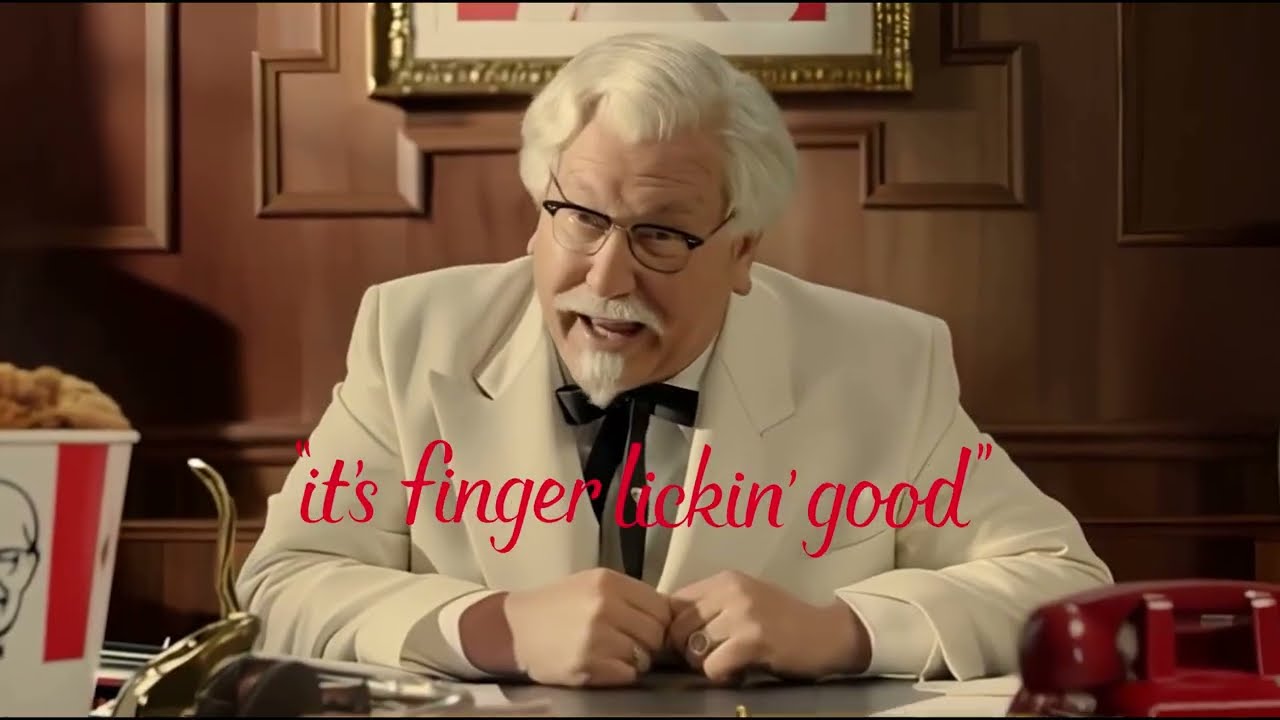
Addicting Ads' clearest public demonstration of broadcast-style Ai production is an unofficial, Ai-generated KFC-style commercial — explicitly disclaimed on screen as not a real KFC advertisement — featuring an animated Colonel Sanders rapping through the brand's menu. It is worth deep-diving on because it demonstrates several distinct Ai capabilities stacked together rather than one single trick:
- Character animation and lip-sync — the Colonel's movements, expressions, and mouth motion are generated to match a fully Ai-synthesized rap vocal, including cadence and rhythm, without a voice actor or motion-capture session.
- Photorealistic product rendering — chicken buckets, saucy nuggets, and combo trays are rendered with the texture and gloss expected of real food photography, without a food stylist, prop table, or photo shoot day.
- Automated scene composition — the Ai sequences close-ups, product shots, and combo-meal presentations, and adjusts cut timing and pacing to the audio track without a human editor building the timeline by hand.
- Brand fidelity — the spot incorporates specific brand assets: the bucket, the Pepsi partnership callout, and named menu items, showing the model was directed with brand guidelines rather than generating generic fried-chicken imagery.
Addicting Ads frames the economics of that spot against traditional production benchmarks: a comparable traditionally-animated commercial would typically need 15–25 animators and specialists working two to four weeks, plus a separate photography budget of $5,000–$15,000 per shoot day for the product shots alone. The Ai version was completed in days, with post-production time — automated cut timing and transitions — reduced by roughly 90% relative to manual editing.
We broke that spot down shot by shot in Deconstructing the Ai-Powered KFC Commercial.
Frame Chain: the continuity technique behind the polish
A recurring problem with generative video is that individual clips look good in isolation but do not connect — cuts feel like jumps rather than a continuous scene, which breaks the sense that an ad was directed rather than assembled. Addicting Ads' answer, developed in April 2025, is a technique the studio calls Frame Chain: the last frame of one generated clip becomes the seed image for the first frame of the next.
In practice, the workflow is four steps: render a clip and capture its final frame; feed that frame back into the model as the visual seed for the next clip; match lighting, angle, and subject across the handoff; and add a crossfade or a few in-between frames if the transition still needs smoothing. The result reads as a continuous shot instead of a cut, which matters most in the first two to three seconds of a video ad — the window in which, per the studio's video-marketing research, most viewers decide whether to keep watching. Addicting Ads reports 34% higher click-through rates on spots using frame chaining versus clips stitched together without it, and applies the technique across its commercial work, including the KFC-style spot above.
The full walkthrough, with examples, is in Frame Chain: A Simple Idea That Makes Ai Videos Flow.
VideoBank: turning the technique into a subscription product
The bespoke commercial work demonstrates capability; VideoBank is where Addicting Ads turns that capability into a repeatable, sellable product for a very specific advertiser: multi-location and franchise businesses — restaurants, QSR chains, and similar rooftop networks that need locally relevant creative for dozens or hundreds of locations at once, something traditional production economics make close to impossible.
The mechanism is straightforward. Instead of one national ad reused everywhere, VideoBank generates fresh, localized Ai video ads for every location in a network and auto-posts them on a weekly cadence, priced at $500 per month per rooftop with the first two months free, no separate production fees, and the ability to cancel at any time. For a franchise operator, that reframes video marketing from an occasional, expensive shoot into an ongoing, per-location subscription line item — the same cost-compression logic driving the wider market's shift toward Ai video, applied specifically to the local-marketing problem that franchise brands have struggled to solve affordably for years.
The production economics, side by side
Addicting Ads publishes its own comparison of Ai-assisted commercial production against a traditional U.S. TV commercial shoot, which lines up closely with the independent market data cited in Part One:
| Factor | Traditional production | Addicting Ads (Ai-assisted) |
|---|---|---|
| Timeline | 4–8 weeks, concept to delivery | 5–7 days |
| Cost (30-sec spot) | $50,000 – $150,000+ | From $5,000/month (1 video) or $10,000/month (4 videos) |
| Crew | 10–20+ people: crew, casting, location scouting | Directed Ai pipeline + creative oversight |
| Variations | New shoot required for each version | Unlimited creative variations for A/B testing |
| Multi-location / franchise | Cost-prohibitive per rooftop | VideoBank: $500/mo per rooftop, auto-posted weekly |
The numbers, charted
Laid out on a chart, the gap between a traditional American commercial shoot and an Ai-assisted production is stark enough to change how often a brand can afford to update its creative. Hover or tab through any bar for what the figure includes.
Traditional range is the standard U.S. benchmark for a 30-second commercial. Ai-assisted figures are Addicting Ads' own published pricing.
Timeline compresses just as sharply. A traditional commercial's concept-to-delivery cycle of four to eight weeks — location scouting, casting, shoot days, editing — becomes five to seven days end to end, since there is no physical production to schedule around.
Both figures are concept to delivered spot, not shoot day to delivery.
The gap is widest for franchise and multi-location advertisers, which is the specific problem VideoBank is built to solve. A traditional local commercial shoot for a single rooftop commonly runs several thousand dollars — cost-prohibitive to repeat across dozens or hundreds of locations. VideoBank instead delivers fresh, localized creative for every rooftop on an ongoing subscription. Drag the slider to size it against a real network.
Based on the published price of $500 per location per month with the first two months free, and the weekly posting cadence VideoBank runs — about 52 videos per location per year. Per-video cost is per location, so it stays flat as the network grows. No separate production fees; cancel any time.
That turns what used to be an occasional, location-by-location expense into one predictable, network-wide line item.
What the entertainment industry is saying about Ai video
Advertising is not the only segment reckoning with generative video — Hollywood is having the same conversation, and it is genuinely split. Some of the industry's most established names have leaned into the technology as a production tool; others have drawn a hard line against it. Both sides are worth hearing, because they frame the same trade-off advertisers are weighing: speed and cost versus craft and control.
Martin Scorsese, director of Goodfellas and The Irishman, joined Ai company Black Forest Labs as an adviser in 2026 and used the technology to storyboard a scene, saying the application can help:
Push the bounds of creativity. — Martin Scorsese
Steven Spielberg has drawn a narrower line — open to Ai as a tool, but not as a replacement for a director or writer's room:
I am not for AI that replaces a creative individual. — Steven Spielberg
Guillermo del Toro has taken the strongest public stance against the technology, choosing to have roughly 1,000 artists hand-rotoscope the 3D re-release of Pan's Labyrinth rather than use Ai conversion:
Absolutely no goddamn AI. — Guillermo del Toro
Phil Wiser, Paramount's Chief Technology Officer, offered a studio executive's middle ground at SXSW, arguing Ai video is best suited to specific production tasks rather than full creative control:
AI isn't sitting in a director's chair, which is probably never going to happen. — Phil Wiser, Paramount CTO
Read together, these four positions map fairly closely onto how Ai video is actually being used in advertising today: as an accelerant for production-heavy, time-sensitive, high-volume creative — exactly the category commercials and franchise marketing fall into — rather than as a replacement for directorial vision on prestige, one-off work. That is the same distinction Addicting Ads draws in its own production model: Ai generation paired with human creative direction, not Ai running unsupervised.
What this means going forward
The broader market data and Addicting Ads' own case work point at the same conclusion from two different directions: Ai video advertising is no longer a question of whether the output looks convincing — recent examples like the KFC-style spot show it clearly can, down to lip-sync, food texture, and brand-accurate product placement. The open questions now are about workflow: how to maintain visual continuity across clips, which Frame Chain addresses directly; how to keep output on-brand at scale; and how to make the economics work for advertisers who were previously priced out of video entirely, which is the specific gap VideoBank is built to close for franchise and multi-location brands.
For an advertiser evaluating this shift, the practical takeaway from the data is narrower than "Ai will replace production." It is that the calculus for local, seasonal, high-volume, and multi-location video creative has changed: the same budget that once bought a handful of shoot days can now fund an ongoing pipeline of fresh, localized, brand-consistent video — which is precisely the position Addicting Ads and VideoBank are built to serve.
If you want the origin story behind the studio itself, start with New Ai Studio, Backed by Tech Giants, Makes TV Commercials You Can't Stop Watching.
Frequently asked questions
How much does an Ai-generated video ad cost compared with a traditional shoot?
A traditional 30-second U.S. commercial runs $50,000 to $150,000 or more once casting, crew, locations, and post-production are counted. Ai-assisted production from Addicting Ads starts at $5,000 per month for one video, or about $2,500 per video at four a month — a 90%+ reduction against the low end of traditional pricing. Independent estimates put fully Ai-generated creative at an 85–95% cost reduction.
How long does an Ai video ad take to produce?
Five to seven days from concept to delivered spot, against four to eight weeks for a traditional shoot. Most of the traditional timeline is scheduling rather than work — crew and talent availability, permits, and a fixed shoot date — and that disappears when there is no physical production.
Is Ai video actually being used by real advertisers, or is it still experimental?
It is in production use. The IAB’s 2025 Digital Video Ad Spend & Strategy Report found roughly 86% of video ad buyers are already using or planning to use generative Ai for ad creative, and projections built on that data put Ai at close to 40% of all digital video ad creative by the end of 2026, up from about 22% in 2024.
What is frame chaining and why does it matter?
Frame Chain is a continuity technique where the last frame of one generated clip becomes the seed image for the first frame of the next, so a sequence reads as a continuous shot instead of a jump cut. Addicting Ads reports 34% higher click-through rates on spots that use it, which matters most in the first two to three seconds — the window where viewers decide whether to keep watching.
How does VideoBank work for a multi-location or franchise brand?
VideoBank generates fresh, localized Ai video ads for every location in a network and auto-posts them weekly, at $500 per month per rooftop with the first two months free, no separate production fees, and cancel any time. It replaces the one-national-ad-reused-everywhere model that franchise brands fall back on because per-location shoots are cost-prohibitive.
The Ai advertising studio behind VideoBank — fresh, localized video ads for every location, backed by NVIDIA Inception, AWS Startups, and Microsoft for Startups.
Every location. Fresh video. Every week.
VideoBank creates localized Ai video ads for your whole network — $500/mo per rooftop, first 2 months free.
Start 2 Months Free